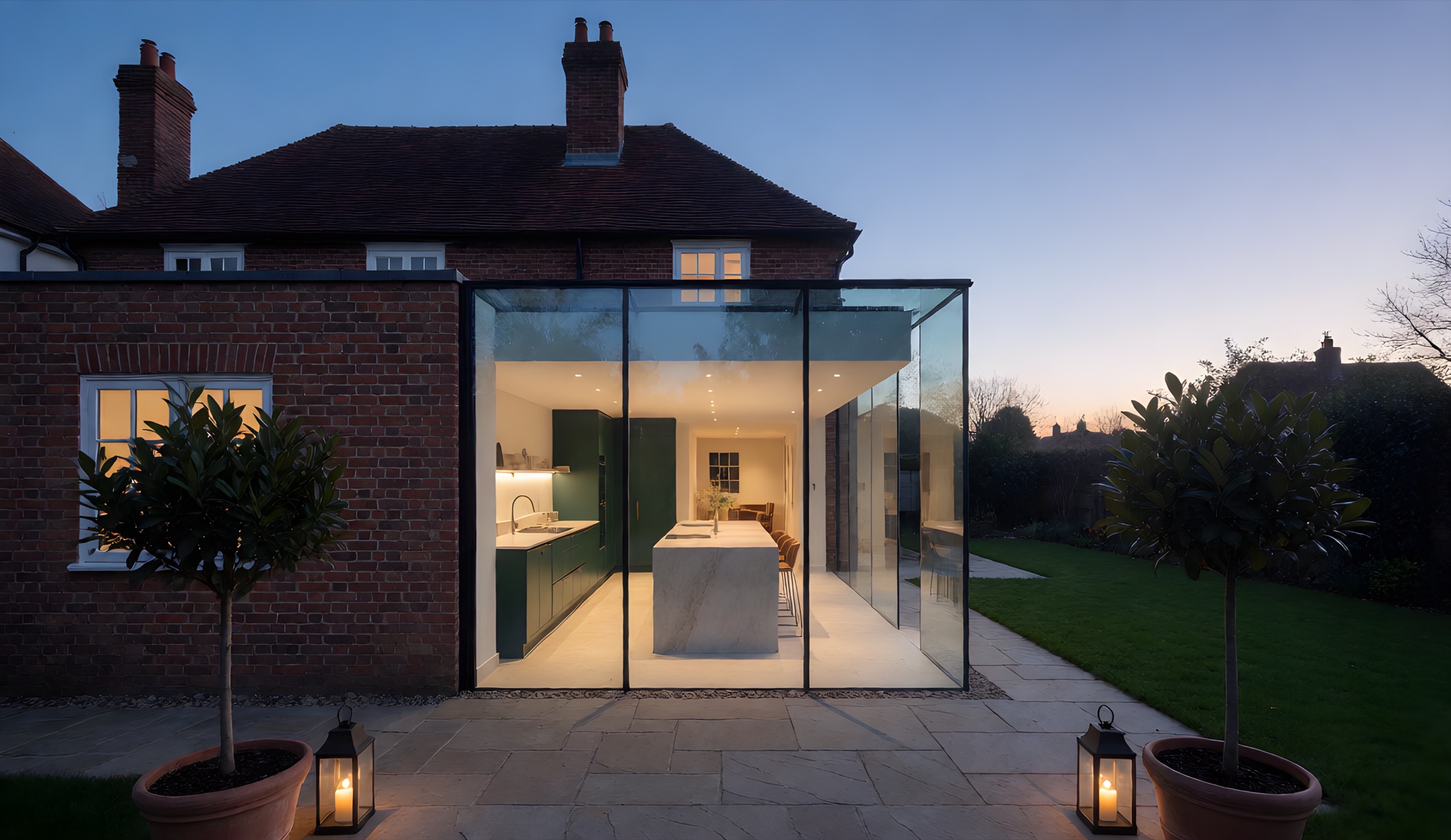
A glass box or orangery kitchen extension is built for light. A glass box uses large panes of glass, sometimes frameless, for the walls and roof, so the kitchen seems to open straight into the garden. An orangery is its more solid cousin: brick piers or a low wall, a flat roof perimeter and a big glazed lantern in the middle, so it feels part of the house while still flooding the kitchen with daylight.
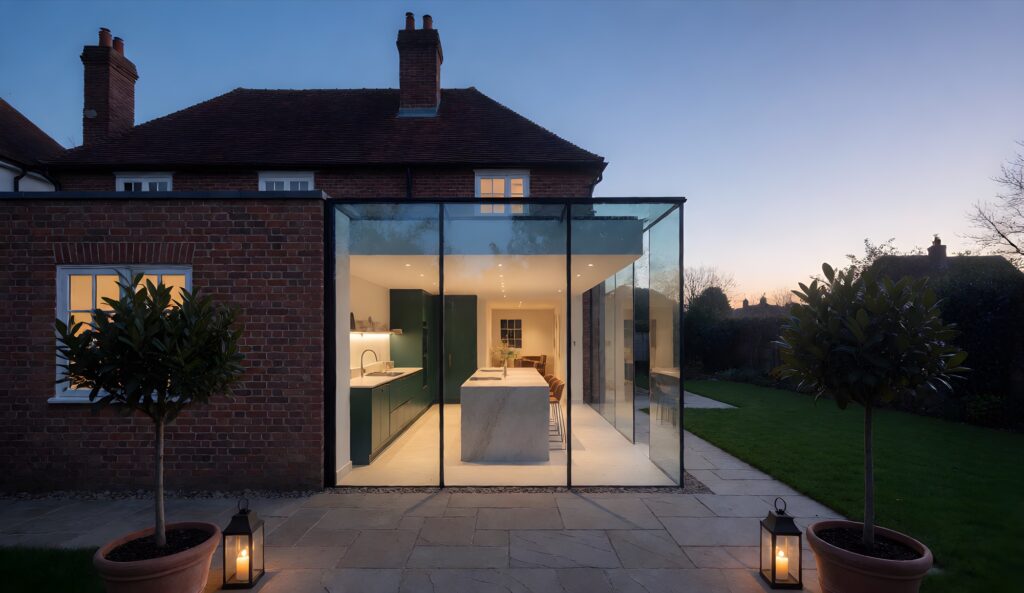
Glass box or orangery: which suits your home?
Glass box
A striking, modern statement. Works beautifully on the back of a period terrace or a detached home where you want the garden to be the view from the kitchen. Most often a small or medium-sized space, sometimes added to a larger rear extension as a glazed end.
Orangery
Brick or rendered piers, a solid roof edge and a roof lantern. It is easier to heat and keep cool than a glass box, can hold wall units, and suits 1930s semis and detached homes that want lots of light without an all-glass look.
Both suit homes across South Essex, from Leigh-on-Sea and Thorpe Bay to Rayleigh and Hockley. If you mainly want a bigger kitchen and the light is a bonus, a rear extension with a roof lantern may give you more space for the money.
How much does a glass box or orangery kitchen extension cost?
Glass is the most expensive part of any extension, so a glass box or orangery costs more per square metre than a solid rear extension. As a guide, a small glass box or orangery kitchen extension in South Essex costs around £34,000 to £46,000 at a good standard of finish, and a medium one around £56,000 to £76,000. The kitchen itself is extra.
| Size | Standard finish | Good finish | Premium finish |
|---|---|---|---|
| Small, about 10 to 15m² | £29k to £39k | £34k to £46k | £42k to £57k |
| Medium, about 15 to 25m² | £48k to £65k | £56k to £76k | £70k to £95k |
| Large, about 25 to 40m² | £77k to £104k | £90k to £122k | £113k to £152k |
These are guide build prices for budgeting, not quotes, and they do not include outside works such as patios, paths and landscaping. Frameless structural glass sits at the top of these ranges or above them; slim aluminium frames and an orangery-style solid roof edge with a lantern bring the cost down. For a figure for your own home, try the 60-second cost estimator.
Keeping a glass kitchen comfortable
A room made mostly of glass has to be designed so it is not too hot in July or too cold in January. The things that make the difference:
- Solar-control glass on the roof and on south and west-facing walls, which lets in light while reflecting much of the heat.
- Opening rooflights or vents high up, so warm air can escape on summer days.
- Underfloor heating, which keeps a glass room warm without radiators taking up wall space you do not have.
- A solid roof edge or part-solid roof, the orangery approach, which cuts heat gain and gives somewhere to put lighting and extraction.
Planning permission and building regulations
A glass box or orangery at the back of the house follows the same permitted development rules as any single-storey rear extension: up to 3 metres deep on a semi or terrace and 4 metres on a detached house, or more through prior approval. In conservation areas and on listed buildings, a glass extension needs planning permission, and a well-designed contemporary glass box is often more welcome there than a pastiche.
A kitchen extension that is open to the house always needs building regulations approval. That includes the energy rules for glazing: when the glass in an extension adds up to more than about a quarter of its floor area, the design has to show the room still meets the energy standard as a whole, usually through better glass, more insulation elsewhere or an energy calculation. We handle this as part of the design. Our planning guide explains the wider rules.
How long does it take?
A glass box or orangery kitchen extension usually takes around 10 to 14 weeks on site. Structural and bespoke glazing is made to measure after the walls and steel are in, which can take several weeks, so we plan the build around the glazing lead time.
Glass box and orangery questions
What is the difference between an orangery and a conservatory?
A conservatory is mostly glass, often with a glazed or polycarbonate roof, and is usually separated from the house by doors. An orangery has a more solid structure, with brick piers and a solid roof edge around a glazed lantern, and as a kitchen extension it is fully open to the house, heated and insulated like any other room.
Will a glass box kitchen be too hot in summer?
Not if it is designed properly. Solar-control glass, opening rooflights and, where the room faces south or west, some solid roof all keep it comfortable.
Does a glass box extension need planning permission?
Often not. If it meets the permitted development limits for a single-storey rear extension it can usually be built without a planning application. Conservation areas, listed buildings and flats need permission. Building regulations approval is always needed.
Is a glass box extension worth the cost?
If light and a connection to the garden matter most to you, yes. A small glass box can transform a dark kitchen at the back of a terrace in a way no solid extension can.